What would you advise…?
Possibly the single question I have been asked through my career: “What would you advise?”. It invites a call to action, a Monday-morning focus if you like. Not ‘What would you do?’ - because as an advisor, that is never my role. The question invites a thoughtful response, not an instinctive reflex. One that would meet the objectives of the asker, create value as they define it. It would help if the answer were logical and supported by data. In short, the question asks for strategic advice - and that’s what my career has been built on…
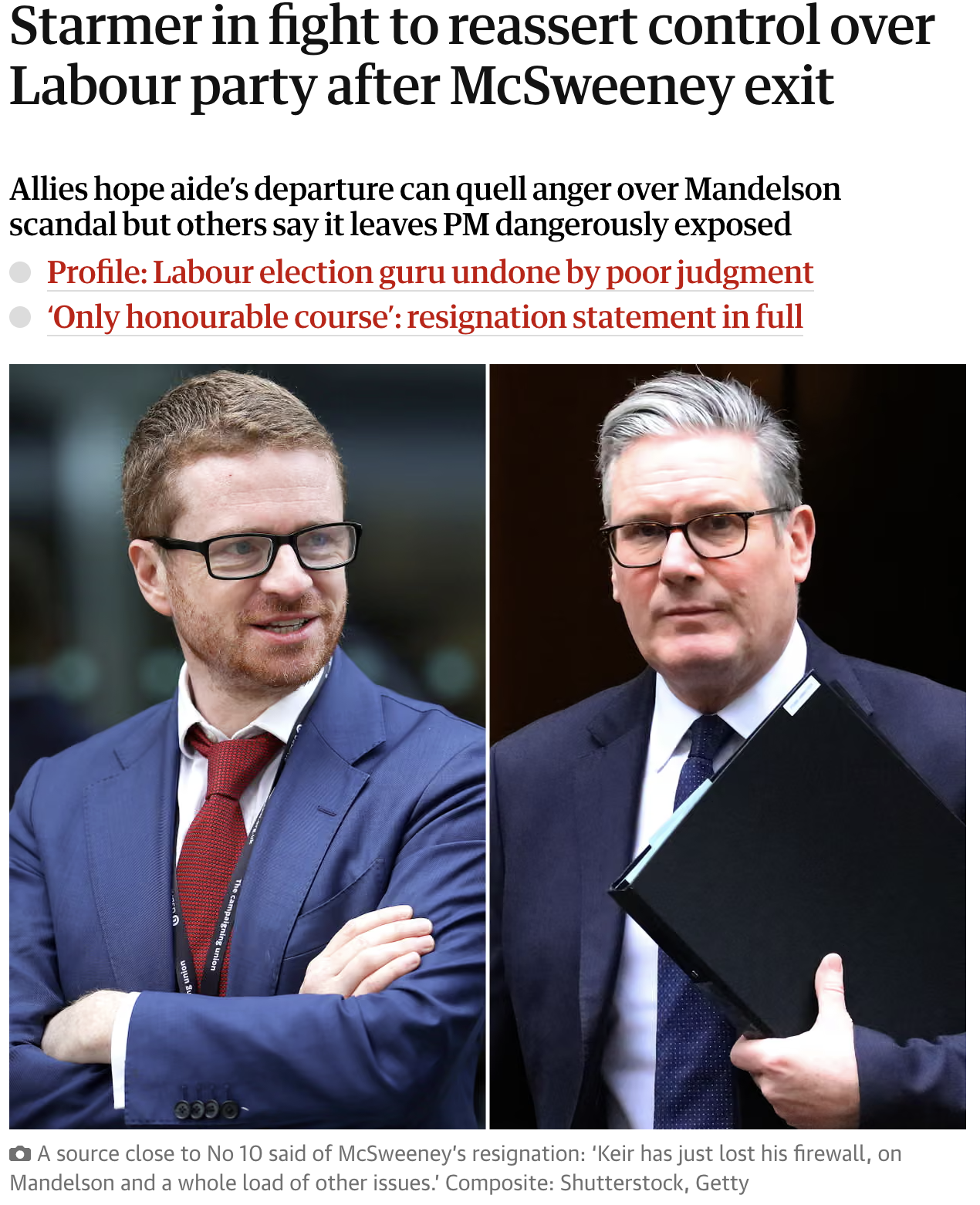
From The Guardian, 8 February 2026
I swipe daily through my news and opinion feeds and ponder all the knee-jerk responses they invite - the endless, mindless drivel, cut neatly up into toddler-friendly bite-size fragments, the never-satisfied bots and agents provocateurs who would have us believe democracy and the rule of law are leading us into some kind of well-meaning but weak-willed, self-inflicted mass extinction. It’s so easy to criticise and complain, but “What would I advise?”
And so I decided to respond to the most recent news to dominate our local airwaves as if I’d been asked the question. The issue is whom should lead Britain now that we have lost our senior prime ministerial adviser, architect of Labour’s landslide and object of dislike and more across many if not all sides of politics? Should Labour plunge itself into a fresh leadership competition, in effect inviting yet another change of Prime Minister through party machination rather than a General Election?
I’ve decided to write “What would I advise?” as a result - I could support with data and analysis but for brevity will keep just the headlines…
The focus on whom should be Labour’s leader is understandable but wrong. Since the landslide Labour has suffered a failure of strategy, of purpose. The government has been authoritarian in its approach to backbench and internal dissent and has not assembled a cabinet of the best available talent. Instead we have one that will agree with the leader. How many must now be ruing the decision to prevent talented, successful, and charismatic Andy Burnham standing for the Commons?
Setting aside factionalism and pet policy wishes, the solution seems blindingly obvious - Personnel, Policy, and Politics must be transformed. And transformation is what I do. So let me see… “What would I advise?”
Personnel: Build A Government Of Talent, Not Yes-People
There is no time or public appetite for a leadership campaign, especially not one to choose a new Prime Minister between elections. Instead, our incumbent leader Keir Starmer must fundamentally re-orient his government. And that must start with picking the best team for the job.
Through my many years in Australia, whenever yet another hopeful England cricket team would arrive in pursuit of Ashes glory, only to find their hopes dashed on rocks named Warne and McGrath, Waugh and Ponting, English commentators and fans would point to occasional, individual performances that offered hope. And the instant Australian comeback was alway this - line the two sides up and ask the question, for each playing position, which England players would you select ahead of their Aussie counterparts if you were picking one team from the two squads?
Think of the undoubted talent available to Labour - the likes of Andy Burnham, Ed Miliband (and his brother David), Emily Thornberry… there are many talented, visionary, and charismatic Labour individuals who on merit rather than politics should be in the Cabinet. Some may need to be brought into Parliament, but that’s not hard. Dare I suggest John McDonnell would make a far better Chancellor than Rachel Reeves whose lack of economic credentials are matched only by her lack of vision and purpose? His desire to nationalise everything that moves can be managed through setting policy guardrails, but his understanding of economics and policy levers and ability to explain them to the public trump those of the incumbent. Labour in 2026 has more leadership strength in depth than the Conservatives, a function of its landslide victory and Boris Johnson’s purge of the Common Sense wing of his party during the Great Tory Brexit Wars. Creating a talent-based list rather than seeking only those who agree with the discredited strategy of appealing to Reform supporters surely makes sense.
Policy: Set Out A Few Key Policy Objectives And Think Big
The government must set out a clear vision that addresses the biggest challenges Britain faces. These are not migration and wokeism. We are a country effectively at war with foreign powers; defence and security must be a top priority. Climate change is threatening our way of life, our economy, the world order/international stability - and our efforts to combat it link intricately with our energy security. AI and the tech landscape have evolved to the point where they offer great opportunity but also nation-changing threats, ranging from the health of our young people, to the stability of our democracy, and the safety and independence of women and minorities. And the country has historically high debt levels, placing public finances on a cliff-edge over which even a modest international financial crisis could push us through raised interest rates or sudden need to increase pubic spend. On this economic point, we cannot escape the reality that significant reductions cannot be made to public spending with touching pensions and benefits. That is where much money is spent and where the big increases of recent years have occurred. Leaving Europe delivered a 5-10% hit to Britain’s economy, and rejoining it or coming as close to that as can be practical delivered in a few years must be a top priority. A simple but ambitious list; all other distractions should be treated as just that.
All these policy specifics must be based in values and a vision, for these are what will bind a broad, talented coalition together - essential when things will get tough, and when disagreements occur over policy detail. That vision must be unique to Labour - not the common denominator across flag-waving xenophobes, tech bros and rthe right-wing traditional media, Trotskyite entryists, and everyone in between. It must be a vision of a progressive, outward looking country. One of diminishing inequality, increasing social mobility. Of humanity and empathy, health and happiness, openness and the rule of law, the importance of science, data and logic over superstition and fear. Most importantly, one that acknowledges and places the common good over individual benefit - yes even if that means taxes and speed limits and vaccinations, curbs on nepotism and lobbying (or corruption as it is more accurately called) and all the other little inconveniences we may need to experience if society is put above our own individual wishes.
TOP POLICY PRIORITIES (no more than 6, each quantified, each to represent a change or opportunity of at least £50 billion)
These would be mine, but obviously the list needs careful analysis and thought. The key thought is that each needs to be big, meaningful, and bold, changey. Not a list of lobby groups and loud voices, wanting ten million here and there and apparently random (although well meaning) laws passed to protect this wetland or that disadvantaged group. There is limited budget, limited capacity for transformation, and limited capacity to create and pass legislation - those should all be prioritised ruthlessly on the significant challenges and changes we must figure out.
Defence and security: Increase investment, ally with Europe and the new Middle Powers. Ukraine IS our war; Israel’s obliteration of a Palestinian state is not. Pivot from complete reliance on an unreliable USA. Begin to mobilise UK institutions to a ‘Cold War’ footing regarding cybercrime, espionage, sabotage
Energy Transition: Accelerate and empower the transition. This offers not only increased security but leads the world through example in fighting the climate crisis. An explicit goal should be developing world-leading industrial and technological capabilities in the transition - whether it’s renewables, transmission, or critical mineral extraction and processing
Get a grip on AI and the tech landscape: Explicit, prioritised investment in capability and infrastructure, and develop clear legal and regulatory/taxation frameworks to manage unwanted side-effects. Every government department and a leading companies to have AI enablement plans in place within 2 years, with access to central funding to support. Think of the flip side being paying taxes through information sharing with government as well as purely money.
Economic plan to break even, in a manageable timeframe: Addressing growth and spending, with fair taxation of individuals and corporates. Pensions and benefits must be part of this, and it needs to pay for investment in defence, AI and the energy transition…
Rejoin Europe: …or get as close to that as is possible in the next 5 years
Build a fairer Britain: Underpin everything with a ‘True North’ value set around increasing equality and social mobility
Politics: Reform Our Consitution
Our electoral system is broken, our upper house is unrepresentative, unaccountable and ineffective. Constitutional reform must be a high priority. But so, too, must building a coalition of progressives to challenge the threat from the populist right. Until we get sensible electoral reform, Labour should reach out and create electoral pacts with talented, like-minded progressives. That means the Lib Dems and the Greens. Would a Labour Government be better, or worse, with Zack Polanski around the cabinet table, and in charge, for instance, of a portfolio around levelling up?
The cost of not doing this is risking embedding right wing populist governments who then make their own changes to ensure they are in power for decades - look no further then MAGA and Project 2026 if you doubt me.
Final Thought: An Office of Government Transformation?
One final thought: Just as I have done when CEOs ask me about their strategy, I urge Keir Starmer not to stop at the ‘What should I do?’, because decades of strategy experience have taught me that “How should I go about it?’ is just as important (but NOT more) a question.
To truly transform this government, and our nation, needs not just the right people, policies, and constitutional framework, but a comprehensive plan and the means to drive action and accountability. An empowered Office of Government Transformation - nothing less - should be tasked with creating, coordinating, and holding to account politicans and government departments to deliver that plan. It’s not, as recent governments seem to think, just about spinning the communications to make ‘sense’ of what’s happening by holding the ‘narrative’ - nor is it about usurping elected representatives to create the real agenda (as McSweeney and Cummings appear to have done in recent years). But it is about creating transparency and the pressure of accountability to support the government deliver on its promise.
Is this all possible? Yes, easily. Is Keir Starmer the man to do it? I argue that is the wrong question? Is it likely?
I shall continue to dream, but without the kind of politican who gets this kind of approach (why does Andy Burnham spring to mind?)…